Baccarat Hands Its 175-Year-Old Chandelier to Bethan Laura Wood, Who Removes the Center Entirely
The Mille Fleurs chandelier reworks Baccarat's historic Zenith design around a hollow core and a palette of emerald, lilac and gold, unveiled at Milan Design Week inside a scenography built like a crystal crypt.
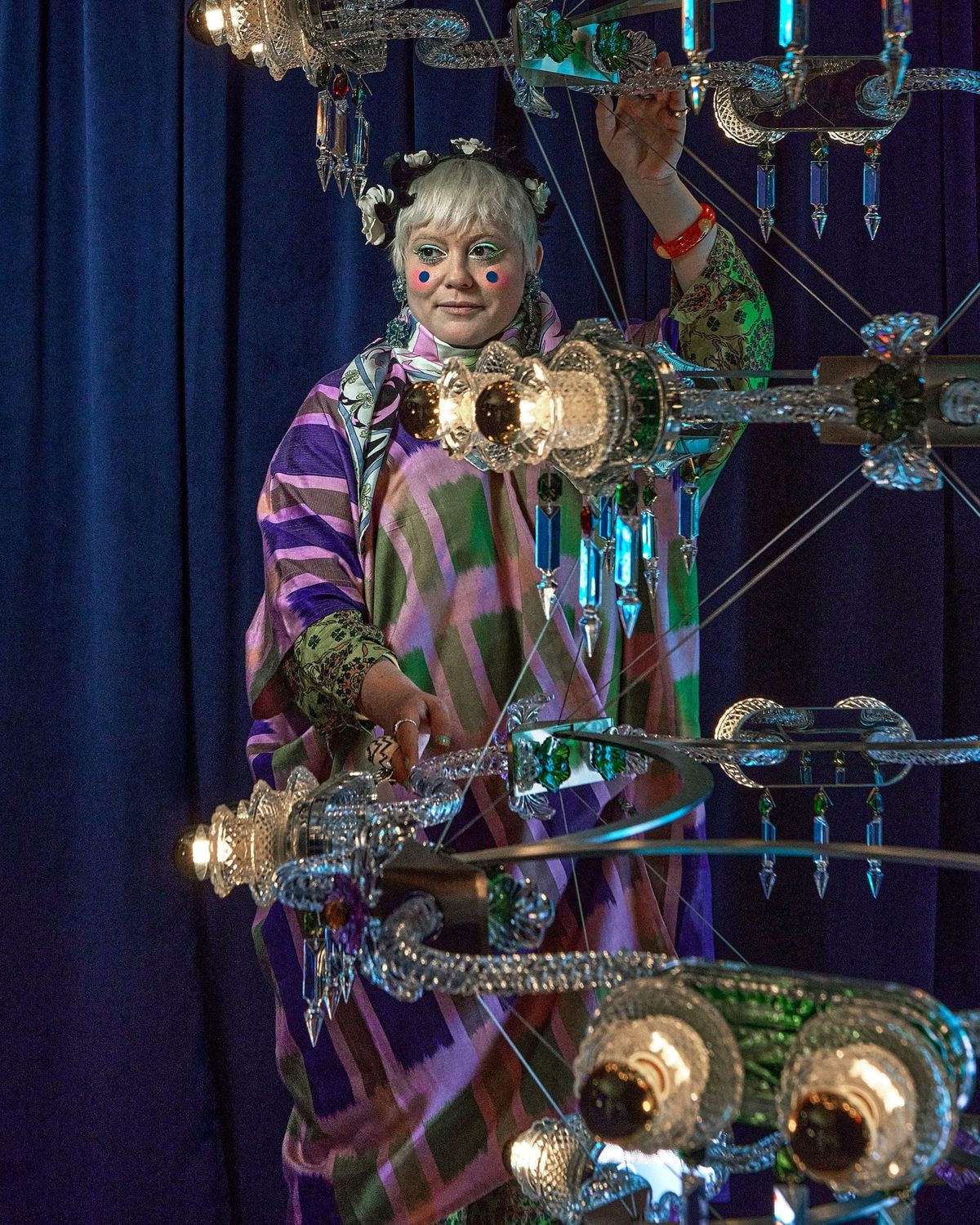
Baccarat's Zenith chandelier has been a fixture of the house's crystal output since around 1850, the kind of design so settled into the brand's identity that reworking it is closer to editing scripture than styling a new product. That is more or less what British designer Bethan Laura Wood did anyway. Her Mille Fleurs chandelier, unveiled as the centerpiece of Baccarat's Crystal Crypt exhibition at Milan Design Week 2026, keeps the Zenith's baroque instincts intact while making one significant structural change: it removes the chandelier's central core entirely.
In its place, Wood suspends rings on tensioned cables, arranged vertically or horizontally rather than fixed to a central armature, producing something closer to a vortex than a fixed candelabra form. Structurally it does something a traditional chandelier design can't: because the pieces aren't locked to one fixed column, the same system can be reconfigured around actual architectural columns rather than working against them. It is a genuinely useful idea dressed up as a decorative one, which is a fairly good description of Wood's design practice generally.
The material story is where the Mille Fleurs name earns itself. Crafted in crystal glass, the collection runs through a palette of forest and emerald green with lilac and gold accents, pulling from an unlikely reference point: Wood has cited 1980s fantasy films, Return to Oz specifically, aiming for what she called "green emerald madness." The florals come from two directions at once, a crystal flower motif lifted from her own 2013 Criss Cross collection, and archival Baccarat flower forms she found digging through the house's own historical designs, plus a new lozenge-shaped element she has nicknamed the pinch lozenge. Matching wall sconces round out the collection, affectionately nicknamed the frogs.
The Crystal Crypt setting did its own work here. Designed by artist Emmanuelle Luciani, the scenography leaned into cathedral aesthetics layered with neon lighting, dancers, and a techno soundscape, treating a 175-year-old glassware house's showcase less like a trade booth and more like a nightclub built inside a chapel. It is an unusually aggressive staging choice for a heritage crystal brand, and it suits the actual product: Wood's chandelier reads as graphically bold from across a room and rewards genuinely close inspection once you're standing under it, which is the same trick the Crypt itself was playing on visitors.
For a brand whose collaborations have run through Nendo, Marcel Wanders and Arik Levy, Wood's version is notable for how much of Baccarat's own archive she pulled forward rather than overwriting. Mille Fleurs isn't a contemporary designer's chandelier that happens to be made by Baccarat, it's Baccarat's own chandelier with its center taken out to see what's left standing. More on the collection is at Dezeen, and Baccarat's wider catalogue is at baccarat.com.


